
Dispatch
Bonnie Prince Charlie and the Battle of Culloden — Part 4: A Letter from King Louis
Brian races to the Jacobite camp with an unopened letter from the King of France — and discovers that Bonnie Prince Charlie was nothing like the fool history made him out to be.
We couldn't contain our laughter. Chris was the first to stop. "So — you're telling me that the Cumberland Sausage was invented the night before the Battle of Culloden, the Duke of Cumberland gained his nickname from asking his cook to make space sausages, and this is also the birth of the first dad joke in revisionist history?"
"I am telling you just that," Hamish nodded assertively.
"Why can he go fast on his motorbike now?" I quizzed. "He was bumping along the track earlier."
Hamish replied, "Well, I think I can tell you the reason at this point. The mysterious lady in the magnificent hat is something of a sorceress. I'd wager she enchanted his bike so he could make the trip back to Inverness in time."
I nodded, satisfied with the answer.
Chris sat back, bemused. "It makes sense? Nothing about this story makes any sense!"
"Makes perfect sense to me," I shrugged.
Brian raced towards Inverness having more fun on his bike than he'd ever had. Speed had no limit. He took corners with his knee almost grazing the ground, pummelling through the night as though the wheels barely touched the earth.
Another faint glow appeared on the horizon — the Jacobite camp. He stopped short of it, hiding his bike off the track a short distance away. Best leave my helmet here too, he decided. Not likely anyone will steal it — and I can't face another interrogation about what kind of cannonball it is.
He was back on the track, pressing forward carefully, when he heard footsteps approaching fast. He had no time to hide or announce himself — they were on him before he'd moved.
A deep, authoritative Scottish voice rang out. "Who goes there? Approach and be identified!"
Brian stepped forward with his hands up, palms open. "My name is Brian McLeod. I've returned from France. I have an urgent message for Prince Charles from King Louis."
A large man came forward and patted him down with efficient thoroughness. Curly grey hair sprawled halfway down his back over shoulders built for hard work and harder fighting. He carried a broadsword at his hip and a gun across his back. He smelled sour. He stepped back, satisfied. "Show me this message. I won't let you near the prince if you're telling lies."
Brian produced the letter from his jacket. The man examined the seal carefully, turning it over. "It looks genuine enough. We don't have time to waste. I'll send you into camp with one of my men." He raised his voice: "Donald, where are you?"
From somewhere amongst the soldiers, a short, squat man came bustling forward. Relieved to be stood down from the night march, Donald agreed readily and led Brian into camp.
"Is this a fashion from France?" Donald asked, eyeing Brian's clothing up and down.
"The finest threads from Paris," Brian said. "Riding clothes. I've lost my horse."
Donald looked puzzled but decided to leave it. "You're lucky Charlie isn't a fussy bugger. I'm sure he'll see you. A letter from the King of France isn't something to dawdle over."
The Jacobite camp was a stark contrast to the Government army's celebrations. No laughter, no music. The men here were hollow-eyed and threadbare, armed with daggers and patched boots that had long since given up trying to look like boots. Donald was cold and hungry, and quietly relieved not to have gone on the march.
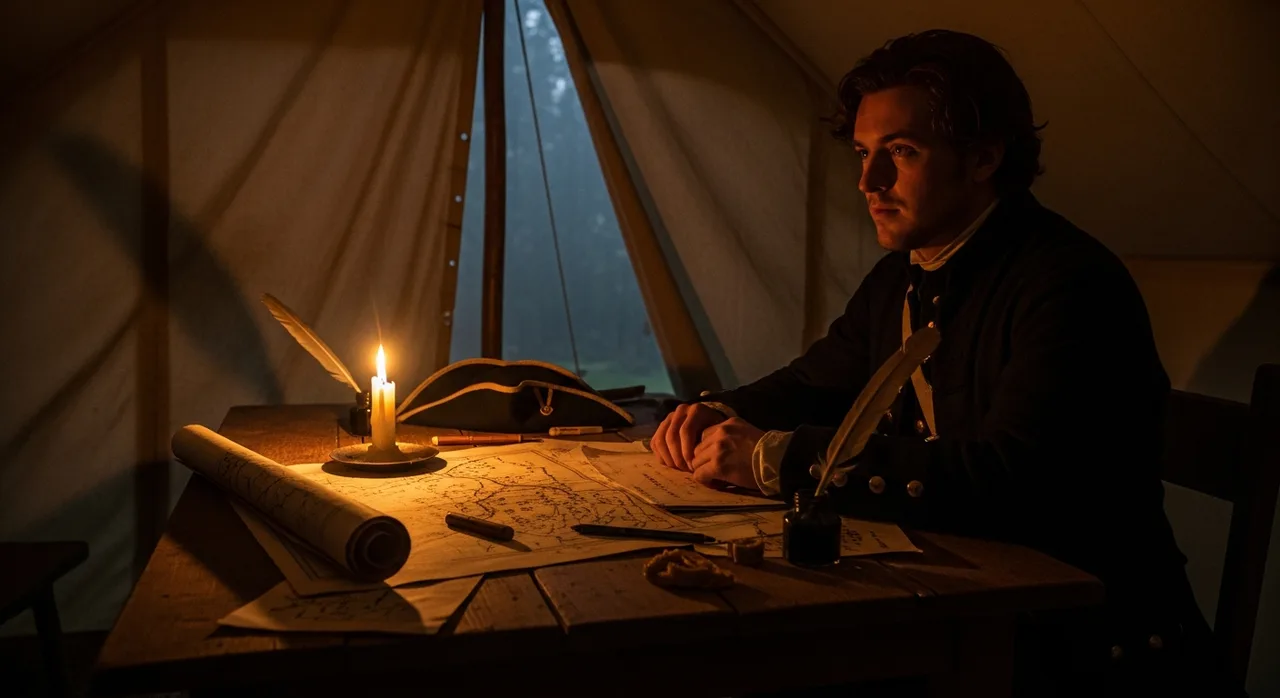
They passed through the sentries to the prince's headquarters. Inside, a large table was covered with papers and maps, and around it stood a group of men in fierce debate about tactics, formations, and the mathematics of survival. At the heart of them sat the man himself — and he looked exactly as someone might look the night before a battle he could not win.
"Excuse me, Your Royal Highness." Donald waited for silence. "We have received news from France — from King Louis. I came across this messenger on the road. The letter bears the king's seal."
Charles flicked a hand. Brian approached and presented the letter. The prince examined the seal. "It looks genuine enough." He broke it open, removed the contents, and skimmed them.
Whatever he had expected, it wasn't what he read. He set the letter down with a sigh and a slow nod.
"It's not what I expected — but it offers hope. Not the hope we want, not the outcome we want, but at least a chance for our survival." He looked around the table at his men. "I think we are all agreed that if we fight here tomorrow, we are all going to die?"
Heads hung low. A murmur of agreement moved through the room.
History had cast him as spoiled, arrogant, tactically incompetent. A fool. A traitor, or a romantic hero, depending on who was telling the story. Not this. Not a clear-eyed man of conscience, reading the room calmly, already knowing when he was beaten and grieving it. Not a leader with empathy enough to spare his men a futile death.
The prince read the full letter aloud. King Louis's proposal: a retreat, gold dispatched by emissaries to the Western Isles, funds to be distributed to the clans so they could survive whatever was coming. The fight might be resumed another day, if another day came.
"Either we follow the instructions within," Charles said, "or we throw our men into battle and certain death. As their leaders — it is for you men to decide."
The large man from the road spoke first, slow and deliberate. "I'm loath to agree with the sentiment of this letter. But I cannot argue with it in its entirety. We are lost if we remain, and throwing lives away for a doomed cause is no wisdom I know." He looked around the table. "Who says aye?"
Every hand went up. For a moment, nobody moved. Then, slowly, the room exhaled.
Brian stepped back as the generals filtered out to muster the men. The camp began to pack up with quiet efficiency. Then the raiding party returned.
They'd been sent out to strike the Government camp by night. They'd found nothing. Now they came back furious, confused, and met with disbelief from everyone they tried to tell.
Brian overheard them at the entrance.
"One minute we were heading for the camp — the next, a fog came from nowhere. We could see nothing. But we could hear them! Laughing and celebrating, but we couldn't get near them. I tell you, it was magic. There's no other explanation."
"Idiots," someone said.
"Witchcraft," said another.
Fights broke out. Months of accumulated exhaustion, fear, and grief boiled over in a spectacular fashion. Someone swung a chicken as an improvised weapon. Feathers went everywhere. Tents came down. Things broke. And then, as abruptly as it had started, it faded — men lay scattered and somewhat lighter for it, and the camp kept moving.
What remained were the prince, a small group of clan representatives, and the horses packed for the Western Isles. And Brian — standing in the middle of an emptying camp, wondering what was supposed to happen next.
Someone needed to fight at Culloden. History would record a battle. The Duke's army was already marching. An empty field solved nothing.
He was still turning this over when he heard it.
His motorbike — roaring along the road from Nairn at truly remarkable speed. And sitting on top of it, hat somehow perfectly intact, was the most miraculous figure he'd ever seen.
Kate arrived at full throttle and braked hard, scattering loose earth in a wide arc.
The prince stared.
Brian smiled.
Kate helped herself off the bike and dropped an elegant curtsy in front of Prince Charles. "Your Highness. I believe you've been expecting me."