
Field note
3,500 listings, 4 exceptions: a grounded AI workflow for motorcycle e-commerce
Over the course of less than 24 hours, more than 3,500 live eBay listings for Bike Wreckers, a UK-based used motorcycle parts business, were enhanced using a human-in-the-loop agentic workflow. The most interesting result wasn't the volume of work completed — it was the review burden: only 4 listings needed human intervention, and about five minutes to resolve.

Artificial intelligence demonstrating its potential — outputs that are increasing sales and helping ready a business for growth.
Over the course of less than 24 hours, more than 3,500 live eBay listings for Bike Wreckers, a UK-based used motorcycle parts business, were enhanced using a human-in-the-loop agentic workflow.
Many of those listings started as basic product records with minimal descriptions and limited structured data. By the end of the process, they contained richer content, improved titles, enhanced item specifics, validated product information and professional, formatted listing descriptions ready for review and publication.
Before building the solution, I spent time researching and testing several platforms that claimed to offer listing enhancement, automation and multi-channel e-commerce integrations. While some showed promise, the solutions that were affordable for a business of this size often failed to deliver the level of accuracy, flexibility and control that was needed.
That led me to a simple question:
Could I build something that performed as well as, or better than, the existing options?
Given the pace of innovation in AI and automation, it felt like the right time to find out.
The answer, at least so far, appears to be yes.
But the most interesting result wasn't the volume of work completed.
It was the review burden.
Out of more than 3,500 processed listings, only 4 required human intervention.
The Challenge
Used motorcycle parts are problematic for e-commerce.
Unlike new products, used parts often have incomplete documentation, inconsistent descriptions, missing manufacturer information, and varying conditions. Listing quality depends on the time and knowledge of the individual creating the listing.
The objective was to build a controlled process where AI could:
- Analyse product images
- Interpret existing descriptions
- Extract identifying information from images
- Search for supporting evidence
- Validate product details
- Populate aspects and fitment information
- Assess confidence levels
- Validate all information on verifiable sources
- Escalate uncertain cases to a human reviewer
This was not designed as full automation. It was designed with human oversight.
Building a Grounded AI Workflow
At the heart of the solution was an agentic workflow using Claude Opus with Gemini Flash.
The workflow was designed to enrich listings while ensuring that outputs remained grounded in evidence rather than assumptions. It has been designed for existing listings, new listings and to implement continuous improvement over time.
A PostgreSQL database served as the central source of truth, automatically synchronised with eBay through the Inventory, Trading, Taxonomy, Catalog, Browse, and other eBay APIs.
For each listing, the workflow processed:
- Existing product descriptions
- Product images
- Current item specifics and aspects
- Historical listing information
AI vision models analysed images to identify products and generate SEO-optimised titles, descriptions and determine condition.
OCR processes extracted visible text, markings, manufacturer references and symbols directly from product images. This information was then used to perform additional searches and validation checks, helping establish confidence in the resulting product data.
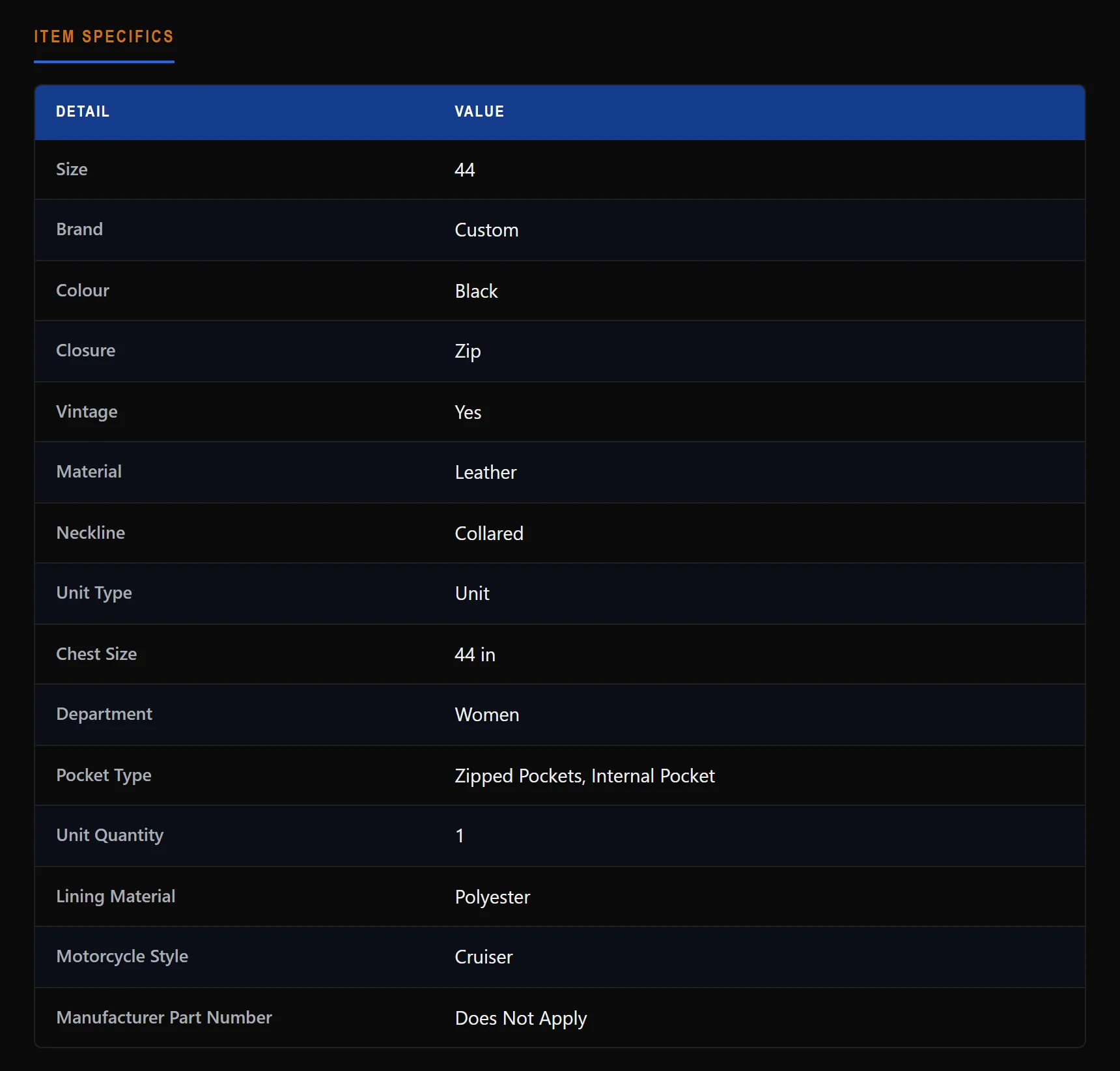
The workflow also queried the internet for manufacturer data, general information and other commerce platforms, as well as eBay's Catalog API and Browse API to identify matching products, manufacturer part numbers (MPNs), ePIDs and supporting product information where available.
Every recommendation generated by the system was validated before any updates were prepared for publication.
Human-in-the-Loop by Design
One of the biggest challenges surrounding AI adoption in e-commerce is hallucination and that is one of the hardest obstacles to overcome.
For good reason.
If AI is free to make assumptions about products, categories or specifications, quality quickly deteriorates and trust disappears.
That is why validation was built into every stage of the workflow.
Rather than publishing uncertain information, the system was designed to identify exceptions and route them back to a human reviewer.
After reviewing more than 3,500 completed listings, the exceptions were remarkable:
- 2 leather jackets with missing size information
- 2 wheels with missing wheel-width details
No hallucinations were identified in the reviewed output because product information was grounded, verified and validated before publication.
The total human review time required?
Five minutes…
Over 3,500 listings… pause on that…
More Than a Listing Enhancement Project
This project has evolved into a broader digital transformation initiative for the business.
Alongside the AI workflows, I have:
- Replaced a legacy HTML listing template that was causing compliance issues and negatively impacting sales performance
- Built a new customer-facing e-commerce website
- Developed a custom inventory and listing management platform
- Created automated workflows for both listing enhancement and new listing generation
- Implemented inventory synchronisation processes to keep eBay listings aligned with a central database, including sold-item management
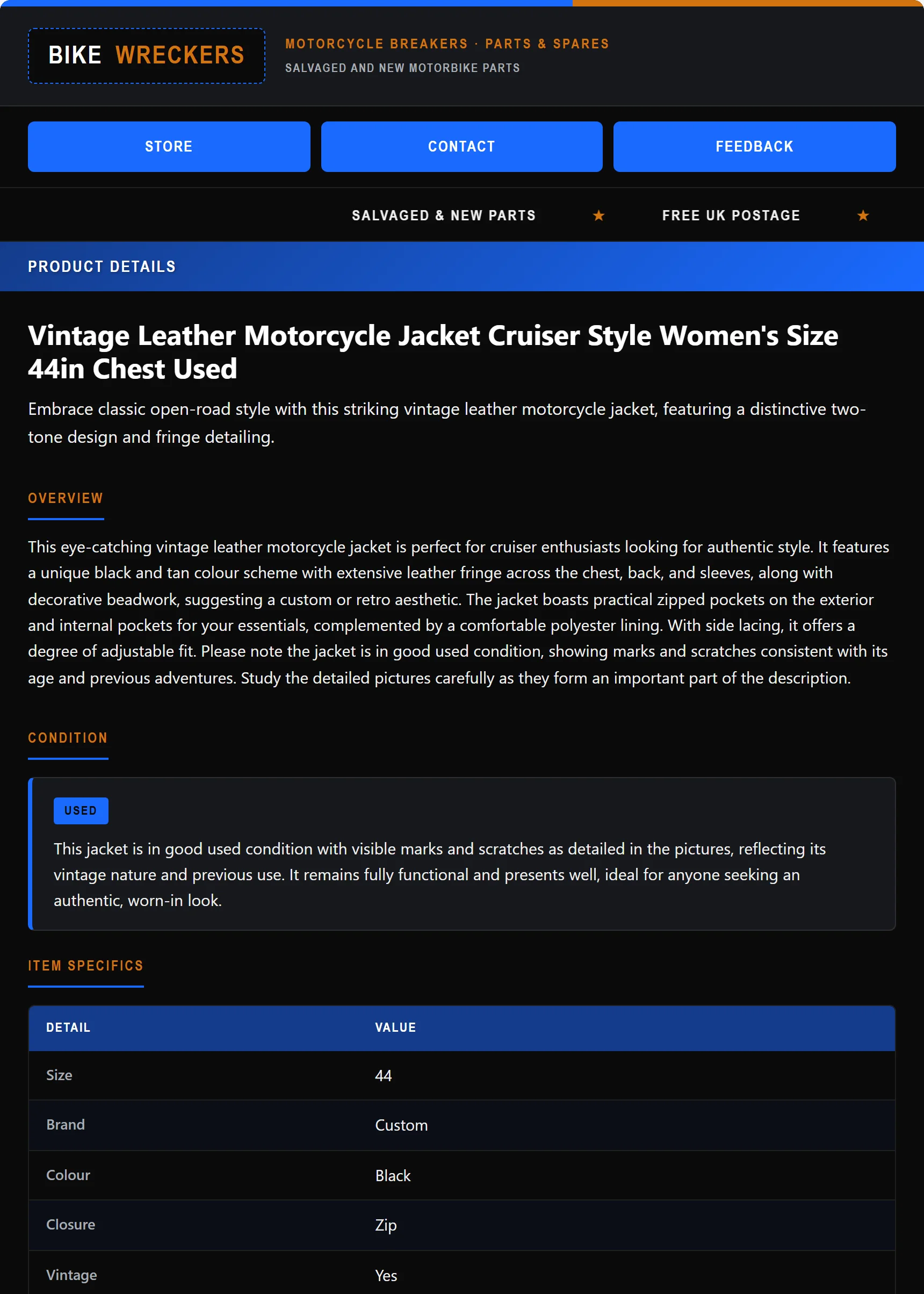
The goal has been to create an ecosystem where inventory, listings, sales channels and operational processes remain connected and consistent.
Early Results
While the project is still ongoing, the early performance figures are encouraging.
Comparing this month to the previous month following implementation:
- Impressions: +24%
- Listing Views: +31%
- Quantity Sold: +60%
- Click-Through Rate: +1.2%
- Sales Conversion: +22%
There are, of course, many factors that can influence e-commerce performance. However, the indicators suggest that improved listing quality, richer product information and better catalogue data are having a significant impact on sales, visibility and conversion rates.
What's Next?
The road map doesn't stop with eBay.
Next stages include:
- Facebook Marketplace integration for motorcycle and used-parts sales
- Amazon and Shopify integration for new inventory
- Merchandise and drop-shipping capabilities
- Enhanced image-processing workflows for existing and new stock
The long-term vision is a connected e-commerce platform that is intelligent, and can manage inventory, listings and sales opportunities across multiple channels.
The Real Value of Agentic Applications
For me, the most important metric from this project isn't the number of listings processed.
It's the review burden.
Reviewing 3,500 listings would take days, weeks even for one person.
The exceptions were simple and took about five minutes to resolve.
That's where AI becomes invaluable. It doesn't eliminate people from the process. It allows people to focus their attention where it creates the greatest value, while repetitive and time-consuming work is automated.
In this example, more time spent building, stripping and fixing motorcycles, and less time at a computer. Things AI can't do today, and I hope for his sake, never can!
When it's implemented well, AI isn't just about generating content faster. It's about building systems that can grow, and are reliable, measurable, and capable of improving business outcomes.
And that's the kind of challenge I find most exciting.
Learn More
- Bike Wreckers website: bikewreckers.co.uk
- Bike Wreckers eBay store: Browse the eBay shop
- More about my work: see what I build